Wednesday, June 30, 2010

Ladyslipper Orchids

Paph. and Phrag., the tropical ladyslipper orchids, are easy to grow and very rewarding. They need re-potting every six months if possible, and they need lots of water with good drainage and light fertilizer. They are long lasting orchids too.

Phragmipedium "Don Wimber" (Eric young x besseae)
I have this one blooming every year. It always gets first place at the show table. After it bloomed four flowers and they faded one by one, I was just about to cut the stem off and I found a new bud forming. So surprised!

Paphiopedilum " Golddollar"
This one didn't bloom last year. This year, it not only bloomed but also had two flowers (usually it only has one flower). It's rare to see two flowers together.

Paph. " Pinocchio" (Three flowers blooming together is very rare! The day after I snapped the picture on the right, one of the flowers fell.)
I highly recommend this one for your orchid collection because they seem to never stop blooming, the buds are produced one after another. This one flowered for 18 months straight two years ago. I will see how long it will last this year. It started to bloom last April and it's still going strong. Do they look like three pairs of lovely dancing shoes?

Friday, June 25, 2010

Sunflower Arrangement


After last week's ikebana lesson, I still have a few beautiful sunflowers left. I randomly made two arrangements using sunflowers to celebrate summer (but it's too hot now!).

Wednesday, June 16, 2010

An Arrangement for Exhibition


My teacher Ms. Lin is going to have workshop for the Taiwanese American Conference/East Coast in two weeks. She's not only teaching ikebana but also will hold a flower arrangement exhibition too. So we all have to make arrangements for this coming event. The table is 3x3x3 ft, so I was thinking my arrangement should not be a small one. I found a handsome wild rose bush and I did a lot of trimming. Together with two big sunflowers and a piece of wood was my original idea, after my teacher's final touch, the result was quite nice. I didn't like the picture I took. It's not as pretty as the real thing. (6/15/10)

Side view and my teacher's piece

Tuesday, June 15, 2010

Wedding Reception Table Arrangement


All right! I am going to try this topic that my teacher just assigned to us, especially since my daughter is planning to get married next summer. She wants me to do some flower arrangements. I think pastel colors are suitable for her. They are soft, feminine, happy and elegant. The pink ribbon is a good touch (my teacher's hint). Maybe I will try something else next year who knows?

Teacher's demo piece and my first version.

Wednesday, June 9, 2010

Cattleyas

These five different kinds of Cattleyas were blooming from time to time in April and May. They lasted from three to six weeks. I have moved most of my orchids outside under two big pine trees. They have been there since Mother's Day and are on vacation now.


Wednesday, June 2, 2010

Slanting Style Nageire Variation No.4


This slanting style variation no. 4 is arranged using Shin 45 degrees, Hikae (the flower) 75 degrees, and omitting Soe. Therefore the overall should look stable and well balanced.
My last white irises, boxwood branches and peony bud are used here. (6/1/10)

Tuesday, June 1, 2010

You in Ikebana

Before my teacher's assignment, I saw these peonies in my garden in full bloom. I knew immediately I wanted to use them in my ikebana. I thought to myself that black pine with peony arranged together might be beautiful.(another material is Pentstimon)
I asked my teacher why she chose this assignment? We are only half way finished all our text books. This lesson is the last one in Book 4. My teacher answered that she wants to push us to do "My Ikebana." Through all the arrangements we've learned so far, we should be able to express ourselves through the plants. What is my self expression here? It's really hard to say. For now, I just know learning ikebana makes me happy and makes me appreciate the beauty of nature more. (6/1/10)

Tuesday, May 18, 2010

With Branches only


Making an arrangement using two or more kinds of branches only.
My classmates' criticism today was that my arrangement looked pretty at first glance, but then you discovered its shape, leaf size, and branch characteristics were too similar (I used a Snow fountain cherry and Red currant--both branches have berries, another one is Crape Myrtle). Now, I certainly understand that it's important to pick branches that contrast with one another, emphasizing their uniqueness. It's a good lesson. (5/18/10)

Iris Arrangement


April showers bring May flowers indeed! My teacher's email said to use Irises as the main part of today's arrangement. She also asked us to bring extra to share if we had a lot of irises in our garden. Gladly I brought some extra yellow and purple Japanese irises to class.
Irises and water usually relate well together. So I used my favorite Suiban. It is big enough to show water and to hold tall flower stems and leaf arrangements at the edge. I combined these with butterfly maple to add more grace and fullness.(5/18/10)

My classmate Mary's Iris arrangement, so beautiful and graceful!

Wednesday, May 5, 2010

Free Style Using Hosta Leaves


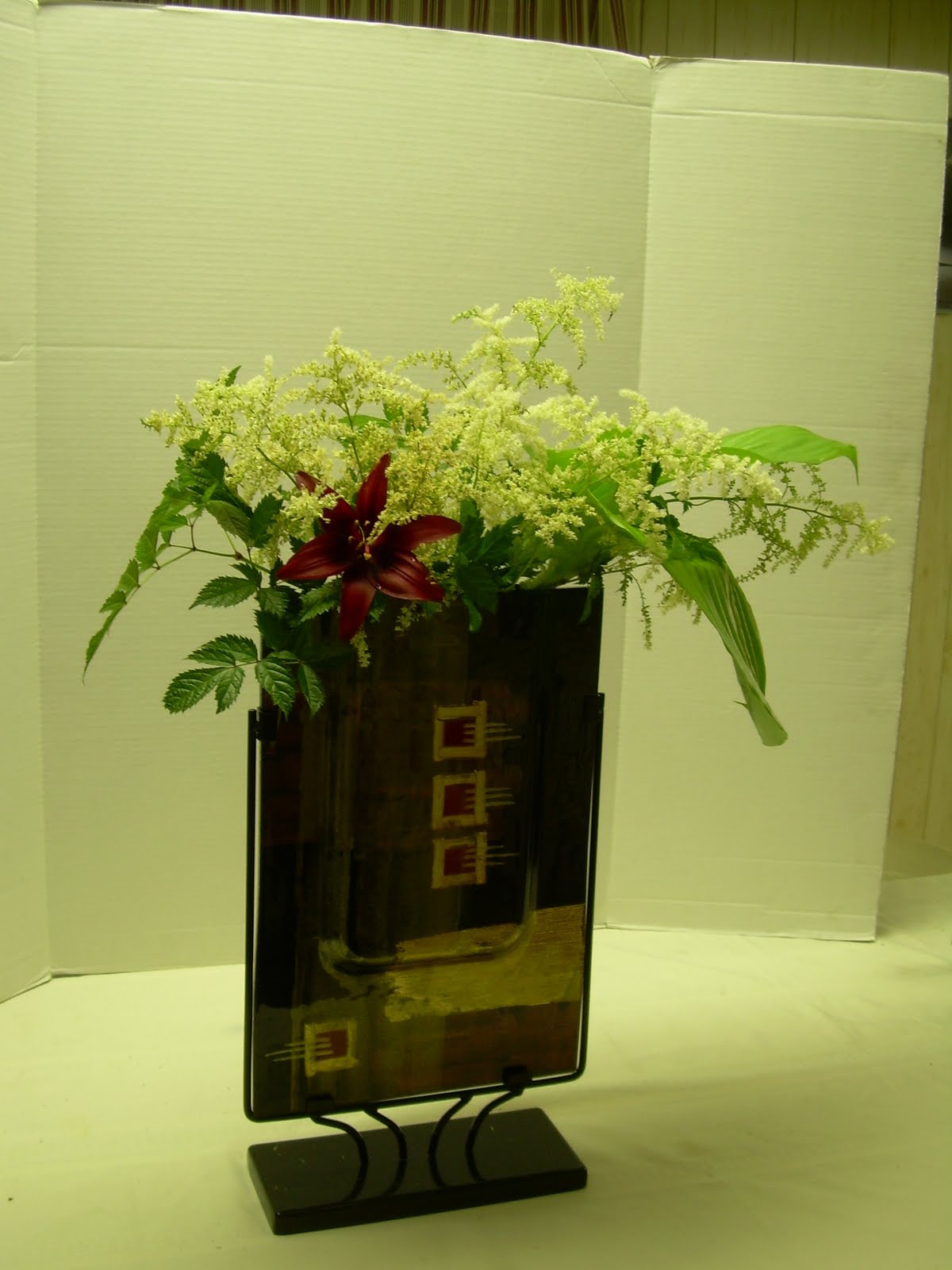
I think many people have Hostas in their garden because of their popularity and beautiful leaves. It's also a perennial! For today's class we had to use at least five Hosta leaves in our arrangement, along with other materials, to create a contemporary style. I had in mind this perfect container for my arrangement. So in class, I used yellow irises and Gaillardias combined with Hostas, but our teacher said it might be better just to use one kind of flower. So I rearranged it at home. It really stands out--the flowers match the container so well! (5/4/10)


This is my teacher's arrangement, very pretty.